Cameron Cassmore
Remarkably Bright CreaturesCameron Cassmore is a young man living on unstable work, borrowed help, and the hope that a clue will lead him to his father. His search takes him from a hungover morning at Welina mobile-home community to Sowell Bay, where he finds work at the aquarium and follows the name Simon Brinks. His story’s decisive turn is not simply that the search yields a family connection: Tova Sullivan recognizes him as her grandson, giving his uncertain pursuit a home and a history he had not expected.
Identity and Background
Cameron’s circumstances are marked by improvisation. After playing with the experimental-metal band Moth Sausage at Dell’s Saloon, he spends the night on Brad Burnett and Elizabeth Burnett’s couch. The next morning, he borrows Brad’s truck and drives to help his aunt Jeanne with a problem involving the clematis vines at her trailer. He is hungover, thirsty, and unceremonious: he swigs from an open can of energy drink, spits it out, and crushes the can. The scene introduces a man who is far from polished, but who will get up early when someone he cares about needs him.
His relationship with Jeanne is unusually close. She is the only person permitted to call him “Cammy,” and when she greets him with the nickname, he jogs over and accepts her quick hug before turning to face the landlord, Delmonico. The detail makes the nickname a small marker of trust and shared history. Later, after a setback, Cameron picks at the fraying cuff of his favorite hoodie while discussing what to do next. The worn clothing and his casual jokes sit alongside real financial uncertainty; they are part of how the book renders his hardship without reducing him to it.
Work, Shelter, and Self-Reliance
Cameron’s living arrangements repeatedly depend on other people’s generosity. When his immediate situation becomes unsettled, he considers finding a new place, perhaps the apartment over Dell’s Saloon. He eventually buys a camper for twelve hundred dollars, negotiating the price down despite its obvious faults. Its engine rattles, a loose belt whines on the drive up I-5, and the replacement belt remains unused in its package in the glove compartment. Jeanne’s money makes the purchase possible, though Cameron regards the arrangement as not quite a loan. Owning the vehicle outright nevertheless feels like a meaningful gain in independence, even when the vehicle itself is unreliable.
Work offers another foothold. Ethan Mack recommends Cameron for an aquarium job and arranges an interview with Terry Bailey, urging him to relax and telling him that Terry is a fish enthusiast. The following morning Cameron returns to the aquarium for the interview. Later, he has taken over sanitation duties there, a job that places him in the building after hours and among its tanks, equipment, and back rooms. His employment does not make him suddenly secure, but it gives him a routine and a setting in which his actions will repeatedly intersect with the aquarium’s vulnerable resident, Marcellus.
That work also exposes Cameron to consequences he would rather avoid. While trying to corral an escaped octopus with a broom handle, he falls, strikes his temple on a table, and wipes blood from the injury onto his shirt. The stepladder is broken, and he recognizes that poorly maintained equipment could make the aquarium liable. Yet he hesitates to complain because explaining what he was doing in the back area could expose his own conduct. The moment brings together his practical awareness, his capacity for rash improvisation, and his tendency to calculate the cost of getting into trouble even while trying to help.
The Search for Simon Brinks
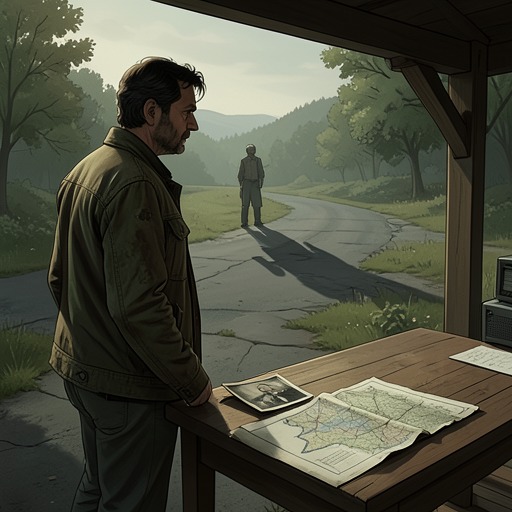
Cameron’s search for his father gains direction through a photograph. While examining scanned yearbook images, he finds a picture of his mother, Daphne Cassmore, standing on a crowded pier with a man whose face is partly hidden against her windblown hair. The caption identifies them as Daphne Cassmore and Simon Brinks. Cameron recognizes the man from the other material he has been studying and immediately searches his name. The results describe Brinks as a prominent Seattle real-estate developer and nightclub owner, with a vacation home featured in the Seattle Times and a Ferrari appearing in a photo spread. The sharp contrast between Cameron’s precarious life and the public images of Brinks gives the clue an emotional as well as investigative charge, though the photograph alone does not settle what Brinks’s connection to Cameron is.
By late July, Cameron has found an old magazine article placing Brinks at a lavish Tuscan-style estate in the San Juan Islands, on a cliff above a strait. He tracks down the address; the drive from Sowell Bay would take two hours each way. Faced with the prospect of making that journey, he scrolls through his phone contacts and pauses over Avery’s number. The hesitation registers the practical and emotional scale of the decision: the search is no longer only a name on a screen but a trip that could put him face to face with the man he has been trying to find.
When Cameron finally encounters Simon Brinks, the meeting is less like confronting a distant public figure than he had imagined. After repeating the name in his mind for two months and studying enlarged photographs of Brinks on billboards, Cameron almost fails to recognize the disheveled man who comes out from behind a bar. His voice turns shaky as he begins to introduce himself; Simon interrupts to say he already knows who Cameron is. The exchange establishes that Simon’s knowledge of him precedes this meeting, while leaving the exact meaning of their connection to what follows in the story.
Money, Generosity, and Independence
Cameron’s finances remain a daily calculation even after he begins to find steadier ground. He saves money through groceries Ethan Mack offers past their expiration date and by parking his camper for free in Ethan’s driveway. He is aware of what he owes Ethan in return. At the same time, the camper represents a future he can picture: looking out at the water each morning from a home of his own. He has considered parking by the shore, but Ethan warns that the overnight patrolman would be glad to tow a camper from a public lot. Cameron’s imagined future is therefore balanced against the immediate limits of money, parking, and other people’s rules.
One night he checks his banking app and sees that his latest paycheck is enough to repay Jeanne in full. He transfers the final amount with an extra sum as a bonus, then sends her a heart emoji. The repayment is a concrete reversal: the relative who helped him buy his vehicle is no longer carrying the financial burden for him. Cameron has only a couple hundred dollars left, and knows he should save it, but he buys digital albums by two lesser-known jam bands and enters Ethan’s email address for delivery. The purchase is both an indulgence and a gesture toward the friend whose food and driveway have helped him get by. The money is limited; what he does with it shows that gratitude and pleasure have not been erased by scarcity.
Family Recognition and Narrative Significance
Tova’s questions make Cameron’s search personal in a way he has not anticipated. She tells him she knows he is in Sowell Bay looking for his father and that he has no relationship with his mother, then asks for his mother’s name. Cameron asks why, and Tova waits rather than forcing an answer. The pause gives the question weight: Daphne’s identity is not merely background information but the point at which Cameron’s search intersects with Tova’s knowledge of the past.
When the family connection becomes clear, Tova sees in Cameron the way Erik’s thoughts once showed on his face, though she also recognizes that Cameron is not identical to him. His eyes, she thinks, must come from Daphne. Tova, who has never been much of a hugger, finds herself drawn to him as his face begins to break apart. He hugs her, and she notices the warmth of his chest and the motor-oil smell of his stained T-shirt—an ordinary, imperfect detail that makes the recognition bodily and present rather than abstract. Cameron tells her, “I have a grandmother.” Tova answers, “Well, how about that? I have a grandson.” The exchange turns his search from an effort to locate an absent father into the discovery of a living relationship. For Tova, it opens a connection to Erik through his son; for Cameron, the family he had been seeking arrives not as an answer on a search page but as a person who reaches back and embraces him.